Tuesday, July 8, 2008

Quick Political Fixes That Don't Work


Going to post another article that is pretty good but pretty boring but has a lot of meaning so read it. I'm too busy right now to do it all myself since I just added a possible lawsuit in Florida over my late uncle's estate. Just gets better and better.


But I realized when I saw this article at MarketMinder.com (full disclosure--I do business with these guys) that none of you have ever seen or been under price controls. Hope you never do because they don't work, ever. Read on.


The high cost of cheap food


Published: October 24 2007 20:37 | Last updated: October 24 2007 20:37


In 1973 Richard Nixon, US president, under political pressure be­cause of rising domestic food prices, banned the export of soyabeans. The policy had predictably dire results, but today, with the world in the grip of another bout of food price inf­lation, governments worldwide are rushing to distort the market with subsidies and quotas, price controls and export taxes. They should stop.


In the run-up to its presidential election, Russia has imposed price controls on basic foodstuffs, and plans an export tariff on wheat. China already controls prices; other importers, including Egypt, Jordan, Bangladesh and Morocco, are increasing subsidies or fiddling with their tariff regimes.


The simple problem with all these actions is that they distort the market. Price controls and export tariffs make production less profitable, which discourages increased supply and can make shortages worse. Subsidies stimulate demand so it does not fall into line with higher prices. All distort the terms of trade within a country. Farmers suffer at the expense of city dwellers – especially perverse in countries with high rural poverty, such as China.


None of this is too bad in the short term. If food prices fall back, price controls become meaningless, subsidies can be withdrawn and export tariffs no longer make sense. The more pernicious problems will appear if food prices stay high. With more demand for protein from fast-growing Asian middle classes, lunatic policies to subsidise corn-based ethanol and the legacy of under­investment during long years of low prices, that prospect seems likely.


For exporters, distorting the market in favour of domestic consumers harms the balance of payments, lowers investment and helps rivals. Nixon’s ban is often credited with creating Brazil’s soyabean industry.


For net food importers, who can keep prices down without shortages only by offering subsides, the risks are much more serious. Cheap food is an open-ended fiscal commitment – once in place it is politically impossible to withdraw – that can play havoc with a budget. Developing countries have improved their fiscal position in recent years. They should not throw that away.


Rich countries, where food is a small part of total consumption, have less to worry about, although they should beware the ratchet effect as food importers increase subsidies and food producers tax exports, driving up world market prices still further. But leaders in the developing world, no matter the political pressure to bring down the cost of grain, should resist. Cheap food comes at a high price.


Monday, July 7, 2008

Employed once more!


Hooray, today I actually got not one but two jobs. Had to turn down one. But this is great news. I had signed up with Spherion (temp agency) a couple weeks ago and they were very excited to talk to me, being that I am a college graduate with computer skills, phone experience, and can speak easily without saying like or ain't. Yesterday they called me to come in and take a Word and Excel test and a drug test for a potential full-time temporary administrative-type position with the bakery branch of a local grocery store chain. So I went in and did that today. The secretary thought I was great and told me semi-confidentially that she pretty much figured I'd get the job because the woman who interviewed me had suggested me individually for this position (the secretary read me the email - the gist was, start with her and you won't need to check 4 other people.) So that was pretty exciting, having been without normal full-time employment for 3 months now, and at home for the last three weeks. After a number of phone calls, they confirmed that I had the position, and I was to start tomorrow morning 8AM sharp. This meant that I would miss the home inspection on the new house but they did not seem to be willing to negotiate starting time. So everything got lined up, and I even got the dog a doggy interview at doggy day care tonight so she could start tomorrow.

THEN I come back from the grocery store and there is an email from the head doc at the private clinic/research organization I interviewed with last Tuesday, who liked me bunches.

Hi Kira --

please give me a call

I'd like to talk with you about a job.

So I call, and Top Doc says, are you still looking for a position, and I say yep, and she says, we're still looking for someone to fill our open spot, and I say, what an amazing coincidence! and she laughs. She asked if I would like to start tomorrow and I asked if Wednesday would be OK so I could go to the home inspection, and she said that was fine. (This is also beneficial because I could totally see the staff getting notice that I'm coming about 5 minutes before I show up. They know that I'm coming in general, but probably not specifically when. So this will give them some time to, say, find an extra desk.) I was so excited I forgot to ask her how much they were going to pay me, but the office manager had asked what my salary expectations were and I said $40-45k so if they're within shouting distance of that, that's great.

These people are as sane as medical clinics get, and just seem like reasonable human beings. I am excited to get back into the thick of things. They have a matching 401k and a health savings account medical plan, so I can bet I'll be posting about that when I get that set up.

Off I go to take Maggie to her doggy daycare interview - there's several doggy daycares in the area, and this one is about five minutes from our house so she won't throw up in the car. (Motion sickness.) It's $75 a week to take her every day, but I'll probably only end up taking her two or three days a week.

This is also excellent timing in that both of my guinea pigs have been seriously ill in the last few weeks, and I'm literally just today not going to be squirting medications and food into either little mouth five times a day. So it's good that I was able to be home to give them more frequent care when they needed it, but also good that when I won't be able to, they won't need it.

Hooray for money! This is exciting!

Sunday, July 6, 2008

Phew.. a lot can happen in a week


It's been a bit busy. I started my new job last Wednesday and things are going pretty good. There was actually some back and forth about how much I was going to get paid.. I talked to Top Doc on the phone who just said, come in and talk to the office manager. So I showed up Wednesday morning and he had a very fuzzy recollection of me - apparently he had gotten about 15 seconds with Top Doc who just said, she's coming. So they had not had a conversation about my salary. He says he'll talk to her, and then for the next few days, I can never find him, plus I keep shuttling between two of the offices. Finally on Thursday evening before I leave, I sent him an email listing what I wanted to talk about (salary plus a couple other things) and said if I couldn't get a hold of him I would call him. I finally got him on the phone about 2PM on Friday and he said that they'd set me at $40k. Which is fine, I told them $40-45k in the interview, and while it is a little less than I used to make, I probably would have accepted less, but it does seem like bad form to cheap out on someone who's already BEEN there three days.

Something that is definitely a bonus though is that instead of working at the main clinic, which is out in the suburbs and is about 20 minutes of highway to reach, I'll be assigned to the downtown office, which is literally about five minutes from my house. So that's pretty awesome. Unfortunately it'll be longer after we move, but definitely not bad at all - about 12 minutes, none highway. If I REALLY wanted to, I could take a bus, with only a few blocks' walk to get to the stops at each end. But that's $41 a month for the bus pass, and I don't know how much the garage pass is going to be, but unlikely to be that much, and 12 minutes drive in each direction is pretty good on gas too. I'm also excited to be downtown because it's actually in a hospital, which means there are a lot of resources (like a cafeteria, a lot more bathrooms, gift shop, etc, as well as being able to schedule tests for my patients onsite.) Downtown also has a lot of lunch restaurants and some street vendors, so I could go out and get all kinds of good stuff.

(for those who used to read regularly, yes, I do now own a car. It is a 2002 Chevy Cavalier with about 9823498 dents, which is why it was about $2700. But it hasn't required much in the way of maintenance and I'll probably drive it into the ground. Driving is WEIRD but fun.)

One really awesome bonus though is that they FEED YOU LUNCH on Mondays and Tuesdays, and sometimes Fridays. Today I actually got two lunches, because I was in the suburban office in the morning when they were passing round the menu. Apparently the drug reps pick a restaurant and we all get to choose what we want off the menu. Most people got an appetizer or dessert in addition to a meal. So I picked out coconut shrimp (which they ended up not having) and chicken parmesan with pasta. Then at about 10:30 I got a call saying that there was someone to see down at the downtown office. I am meeting with the most experienced coordinator down there frequently for training. So by then the order was already in, and I went downtown before lunch arrived. And what do you know but they had Panera boxed lunches. Five kinds of awesome. So I got Panera for lunch, and my chicken parmesan was there when I got back to the suburban office. Hooray for free lunch! I am totally going to milk that. I don't think they do the menu ordering at the office I'll be at, but free food is still awesome.

In house news, we did our inspection on Tuesday, and there are of course a few problems. The ones we were most concerned with were the wiring and the hot water heater. The house is about 100 years old, so the wiring is pretty old, but it looks like someone rewired the downstairs but not the upstairs. The upstairs is not grounded at all, and there is knob and tube wiring in the attic that is under a foot of insulation. How this was explained to me as bad is that knob and tube has nice big copper cables, which can be good because they are much thicker than wires used today, and usually enclosed in a wall with air all around them to let heat escape. So being under a foot of insulation means the heat can't escape and this is a fire safety issue. So that's bad. The other big issue is that the hot water heater's air outlet is not drafting properly. The house has two chimneys and the air is supposed to go up one of them, and it's not. This might be because the chimney is full of leaves and crap, or it might be that the chimney has collapsed internally. Who knows. Not our problem. It's a safety risk. So we asked on our request to remedy that they replace and ground the upstairs wiring, and that they fix the hot water heater so it's drafting properly and the basement doesn't fill up with carbon monoxide. That's bad. We're waiting to hear back from them probably tomorrow about what they're going to do.

We also went in early this morning and Boyfriend signed lock papers. We are locked in at 6.25% paying half a point of discount (probably covered under what the seller is paying) and given the way the markets look now, that's probably the best we'd be likely to get, even given what our mortgage person was up to. When we first met she had said 6.25% with no points, but this is acceptable given that we are putting so little down.

In completely unrelated news, I've also been spending money on clothes. This is kind of new for me, and I forgot how much I actually really enjoy having nice clothes and looking like an adult. At my last job I kind of fell into wearing the same pants every day with different solid colored t-shirts and long sleeved t-shirts, and I felt like I was starting to look my age. (this is not something you want when you are as young as I am in the professional world where people have to trust you are providing accurate, potentially life-altering decision-making information.) So I spent some time at the outlets on Tuesday and spent about $250 on clothes, and for this got six dresses, a couple tops, and some assorted other items. Went to a different store a couple days ago and spent $75 on four dresses. Kind of getting into dresses now, to some extent. But like the commercials say, feeling like a grown-up at your new job: priceless. I'm going to try to weed out some of my older, less attractive clothes and slowly turn over my wardrobe. At this point, if I can't wear it to work, there hardly seems a point in buying it since I already have plenty of t-shirts and shorts, and you can wear black pants any day. I do need to buy some black closed toed shoes that I can wear barefoot, since I a) hate pantyhose b) bought a bunch of knee length skirts and dresses and c) you can't wear open toed shoes in a hospital. So that might end up costing more than my outfit on any given day, but hey, no one said looking like a grown-up was cheap.

Saturday, July 5, 2008

Five Basics for Your Finances


For those of you who missed this...

New York Times
: Your Money
Five Basics for Building a Solid Financial Future
Published: May 17, 2008
A new Times columnist offers guidance for making financial decisions, when making good ones is more critical than ever.

Read the full article here.


(Sorry, I can't figure out how to delete this darn "read more" link, so ignore it here.)


Friday, July 4, 2008

2008 CONUS COLA rates


A few months ago, I posted about CONUS COLA, as it was a new entitlement for Mr. Dimes. For the uninitiated, CONUS COLA is a taxable income supplement for living expenses in an area (as opposed to housing expenses, which are covered by BAH). It increases or decreases every year, and can appear or disappear altogether for certain areas. For 2008, a handy calculator is available at this site. An official list of sites receiving COLA as well as the percentage rate can be found on this Pentagon site, where the list is a PDF file. If your location is not listed, you are not eligible to receive CONUS COLA. A handful of locations that were previously receiving it lost it for 2008, though they may get it again in future years.

Thursday, July 3, 2008

California--A Nice Place To Visit But I Wouldn't Want To Live There


Went out to the Bay Area for my niece's wedding. Great trip, had fun, glad to be home given the price of houses and a wee bit of overcrowding. Seems that I am not the only one glad to be out as outlined in this article at MarketMinder.com. Enjoy--if you can.


California Hates the Poor


10/5/2007 |


California hates the poor. At least the Golden State certainly seems to act that way, given the way it treats its lower-income residents.


But wait—isn’t California known as one of the most socially progressive states, spending billions of dollars on social programs and public assistance for low-income residents each year? Indeed! Yet Californian legislators uphold a policy choking off precious dollars that could go to residents needing it most. That wacky policy is the Golden State’s tax structure.


California boasts the most punitive state income tax system in the entire Union. (Not so fast New Jersey, Hawaii, Iowa, and Oregon! Though you’re all nearly as bad.) With so much wealth in the state, you might not feel much immediate sympathy for those paying the lion’s share of the state taxes. After all, California’s got Hollywood movie stars, celebutants, and Dot-Com-mega-billionaires! Make them pay! Folks tend to forget California has millions of souls—the vast majority are Average Joes.


Let’s examine the current tax structure. California income taxes kick in at a modest 1% rate for annual income up to $6,622. Not too bad—$6,622 seems a small amount to hit up for income tax, but 1% isn’t that much. But, California’s highest tax bracket of 9.3% (the highest in the nation) begins at the affluent, wallet-busting, Bentley-driving sum of $43,468.


I’ll repeat that. California imposes the nation’s highest state income tax level of 9.3% on residents earning more than $43,468. Some perspective: In 2004, the US Census reported California’s median income was $51,185—higher than America’s median income of $44,648. Translation: If you’re “middle class,” California wants 9.3% of your income. It’s a shakedown for your lunch money.


Meanwhile, nearby states Washington, Nevada, and Texas charge no state income tax at all. Arizona starts its highest tax bracket at $150,000 where residents pay 4.57%—less than half California’s top rate. It’s hardly surprising these states are some of America’s fastest growing states. In 2006, Arizona’s and Nevada’s populations swelled over 4 times faster than California’s.


If you’re a Californian with a nice retirement savings, where would you retire? California wants a hefty portion of your retirement income every year, whereas nearby Washington and Nevada want none. Add to the equation the far lower cost of living in those states, and relocating seems like a no brainer. So, folks leave and California ends up with none of their income, property, or sales tax revenue.


Those poor souls remaining in California end up with less money to fund public schools, build new roads, pay for social programs and so on. All thanks to politicians ignoring fundamental economic principles and placing too heavy a burden on its working residents and businesses.


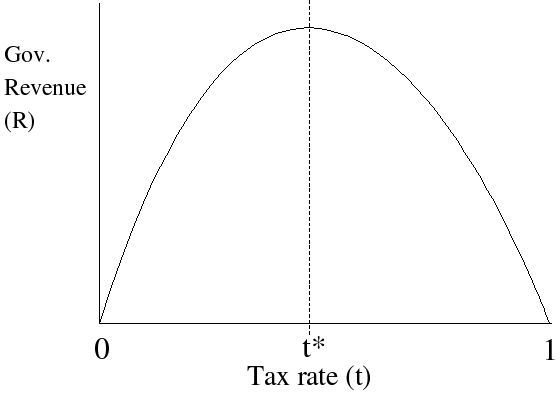
When a state places too heavy a tax burden on its citizens or businesses, the government stifles consumer spending, business investment, and actually ends up collecting far less tax revenue. A government can maximize its tax revenue at an optimal point. Tax too much and folks don’t see much of a reason to get out of bed in the morning. Mrs. Entrepreneur fails to see the upside in launching her cutting-edge new business idea. Less business activity means less tax revenue. The Laffer Curve (shown here http://upload.wikimedia.org/wikipedia/commons/4/47/Laffer_Curve.png) demonstrates the concept.


If prohibitive taxation makes a difference between US states, one could also apply the concept to countries. When a nation imposes high hurdles for new business development and wealth creation, the prospect of strong economic growth becomes increasingly remote. Conversely, if a country slashes corporate tax rates to spur economic activity, all other factors remaining constant, that’s bullish for growth.


Take Ireland for example. The Emerald Isle slashed its corporate tax rate to 12.5%—one of the lowest rates in the developed world.


Selected Corporate Tax Rates by Country


Ireland 12.5%
Netherlands 25.5%
United Kingdom 30.0%
China 33.0%
Belgium 33.9%
France 34.4%
Germany 38.6%
USA 39.5%
Japan 39.5%


Much to the chagrin of France and other EU heavyweights, economic growth in Ireland is soaring! After all, entrepreneurs and existing businesses only need two very simple elements to justify a venture: profit and human capital. Ireland has an educated, English-speaking work force and a corporate tax rate low enough to entice entrepreneurs from around the globe. Ireland will likely attract business activity, people, and tax revenue other countries will miss out on. It shouldn’t be much surprise, then, that Irish GDP growth is expected to more than double the EU’s average. Erin go bragh!


Eastern Bloc countries are also joining the low-tax party. Estonia, Latvia, Russia, Ukraine, Slovakia, Romania, Georgia, and Macedonia all successfully introduced low flat tax structures in recent years. These moves now pressure Western European countries to either become more competitive with their business climates or face a hemorrhaging economic growth towards their neighbors with cheap labor and more welcoming tax structures.


With one of the largest gross domestic products in the world, one could only dream of the economic boom resulting from slashed California tax rates (not to mention falling federal tax rates). With the Irelands and Nevadas out there, Uncle Sam and the Golden State better act fast. Their poor depend on it.


Oil Speculators Aren’t The Problem


There's a very interesting Fortune article entitled In Defense of Oil ‘Speculators' that I recommend checking out.


I am not an expert on the energy markets, and therefore I appreciated this article, which explains in simple terms some basic economic and futures trading principles - and common misconceptions. Here are a few interesting quotes:


If our representatives did understand the oil markets, they'd know that the true telltale sign of a speculative bubble is not rising trading volumes but rising oil inventories. Speculators would be hoarding oil - building up inventories either in anticipation of higher prices or as part of a scheme to drive prices there. Yet according to the Department of Energy, U.S. oil inventories are now at below-average levels. U.S. oil stocks stand at 309 million barrels, versus 330 million in June 2005.


...


By providing a mechanism for locking in prices, the futures market makes it easier for oil companies to make costly investments in new production - which is the key to lowering prices at the pump.


Futures trading also discourages hoarding in an otherwise tight market. Without speculators willing to take the other side of so many futures contracts, oil refiners and other end-users might be inclined to ramp up their spot-market purchases and store more oil as a hedge against further price increases.


...


Even if you believe there's no way that oil trading volumes could be soaring without influencing oil prices, remember that influence then has to run two ways.


If an index fund is indirectly driving up spot oil prices every time it buys a future, then the converse must be true, too - there must be an equal and opposite downward push on spot prices every time that future is sold. In other words, futures market critics can't have it both ways.


There's something else politicians conveniently overlook: futures trading requires two to tango. For every investor who is betting oil prices will go up, there also needs to be an investor willing to take the opposite side of that bet.


There is a lot more in the article itself. Read it for yourself and share your thoughts. Do you think oil speculators are to blame for volatility in the energy market? And, more importantly, what effect do you think increased congressional legislation on the matter will have?


More from Meg at The World of Wealth


ShareThis